Wednesday, December 31, 2008

Saturday, December 20, 2008


Wednesday, November 26, 2008
Holiday Anime Faire `08
On December 6th, I’ll be at the Holiday Anime Faire teaching with Manga Start a class on body expressions. Stop on by!
Wednesday, November 19, 2008

Monday, November 17, 2008
CAEA Manga Presentation Thank You
Thank you to the 50 plus art educators to came to Sakura of America's Intro to Manga Presentation! I was grateful to see so many educators willing to get up early and be interested in manga. Again, if you have any questions, please feel free to ask here or on Manga Start.
Thursday, November 13, 2008
CAEA Manga Presentation
I'll be teaching a workshop with Manga Start at the California Art Education Association this Saturday, November 15th. The workshop description:
Introduction to Manga for Classroom Art Education
Manga (Japanese Comics) is captivating your students’ interest. Learn more about this unique genre from Professional manga artists, and gain insight on connecting manga with traditional classroom art education.
Introduction to Manga for Classroom Art Education
Manga (Japanese Comics) is captivating your students’ interest. Learn more about this unique genre from Professional manga artists, and gain insight on connecting manga with traditional classroom art education.
Wednesday, November 05, 2008
Raconteur update and Manga Start
A new comic page is up!
I'm helping out with Manga Start. Check out the site for manga style tutorials!
I'm helping out with Manga Start. Check out the site for manga style tutorials!
Wednesday, October 22, 2008
Tuesday, October 07, 2008
Raconteur update
After I replace my dead laptop, the current story on Girlamatic.com will resume this month.
Tuesday, September 16, 2008
ground and pound
Here are some gesture drawings while watching UFC fights on TV. I used a brush pen and they weren't more than a couple minutes using a freeze frame option on the TV remote.


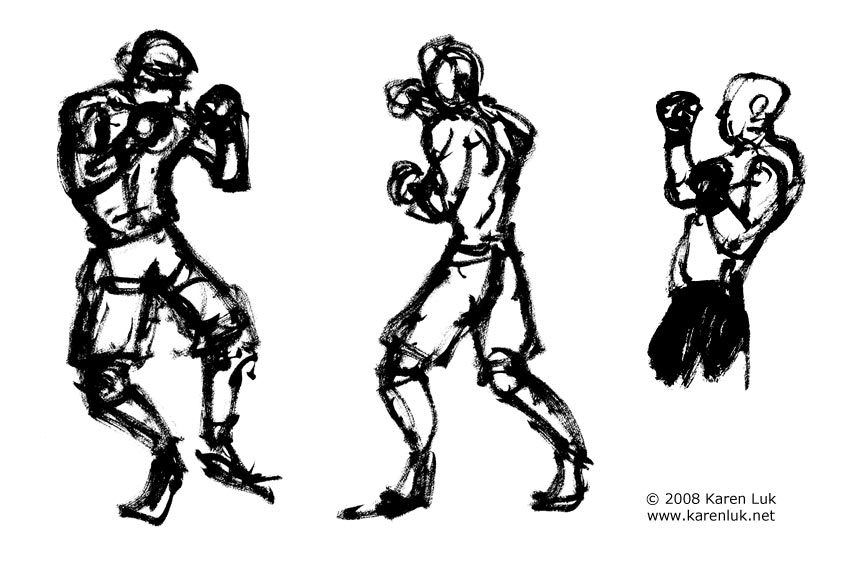
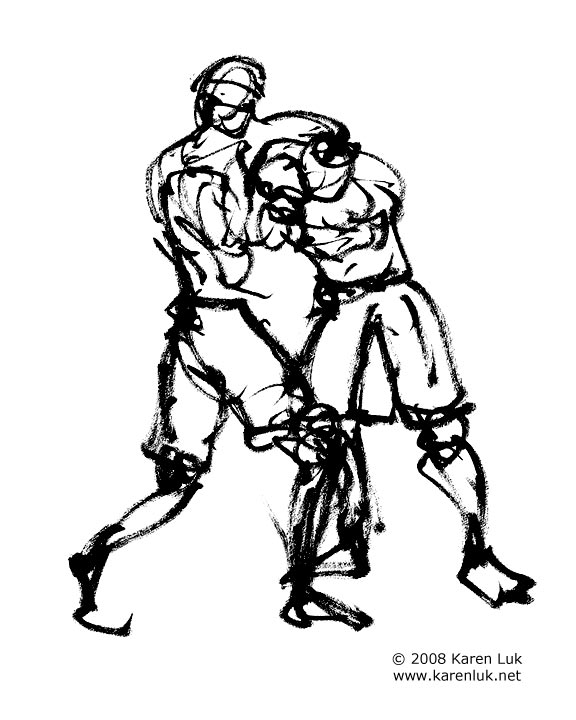
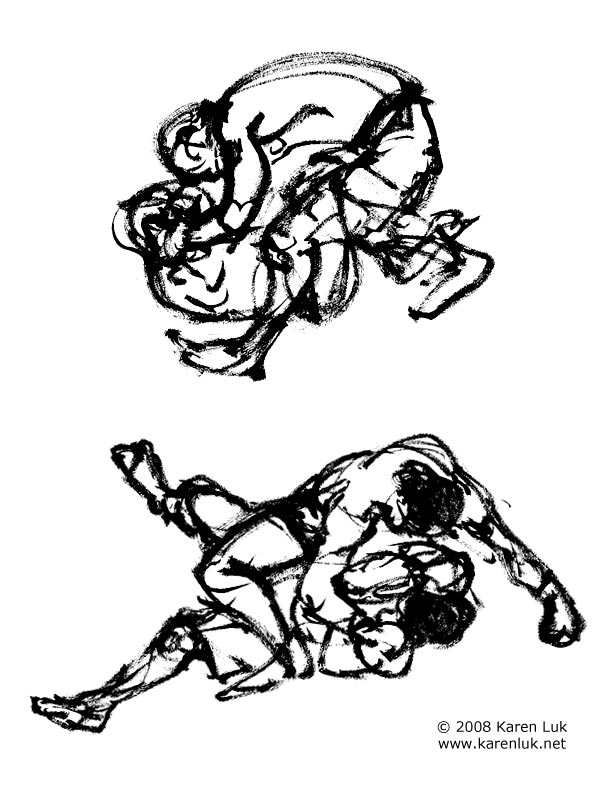
Saturday, August 30, 2008
Mendocino jam comic
Here's the jam comic from the Manga Festival in Fort Bragg, CA. I had a great sharing drawing hints and skills with attendees. Enjoy!


Wednesday, August 06, 2008
Manga workshop on the Mendocino Coast
I will be teaching a manga workshop on August 23rd at Racines. The workshop will cover facial/body expressions, character design and a jam comic. Sign ups at the store are recommended!
Tuesday, July 22, 2008
San Diego Comic Con starts tomorrow!
A reminder: I will be doing sketches for donations at the Cartoon Art Museum table on Friday, July 25th from 2-3 pm. The museum's table is on the mezzanine level in the Fan Club section, number MZ11. According to the staff, it’s $10 for a 5.5x8.5 and $25 for a 8.5x11. It may be different once there, but it’s a heads up. Come on by!
Here’s a logo design I finished for a gaming group:

Any fan of The Red Star will enjoy this. I will color it later:

Here’s a logo design I finished for a gaming group:
Any fan of The Red Star will enjoy this. I will color it later:

Wednesday, July 16, 2008
sketches at SDCC!
San Diego Comic Con is just around the corner! I don't have a table, so I'll be roaming as a free agent on the floor. I will be doing sketches for donations at the Cartoon Art Museum table on Friday, July 25th from 2-3 pm. CAM's table is on the mezzanine level in the Fan Club section, number MZ11. Come on by!
Wednesday, June 25, 2008
Raconteur update
Here's the latest page of my current story Treaty. After this story is done, I'll be putting Raconteur on hiatus for a while.
Sunday, June 15, 2008
Tuesday, May 27, 2008

Thursday, May 22, 2008
MoCCA bound!
Mark your calendars: Leigh Dragoon, Karen Luk and Rachel Nabors will be at MoCCA! We're at table S41, on the second floor of the Puck Building.


Monday, May 12, 2008
Art Spiegelman and Chris Ware, Serial Boxes, April 30th
Chris Ware and Art Spiegelman were guest speakers at the Jewish Community Center of San Francisco on April 30th. Their conversation, as guided by Heidi Chute, was part of Serial Boxes – a series of lectures exploring the graphic novel.
Ware is known for his graphic and geometric comics that look computer generated, but is done by hand. His notable works include the Acme Novelty Library and Jimmy Corrigan, the Smartest Kid on Earth. Spiegelman’s underground comics work began in the 1960s and 1970s and continued with co-founding of Arcade and Raw. His Pulitzer-winning Maus elevated graphic novels to literary status. He equated his recent work, In the Shadow of Two Towers, as current generation’s World War II influence.
Spiegelman believes that graphic novels are still bidding for respectability. The graphic novel is a medium, not a genre. He views the term “graphic novel” as a marketing term, instead of just saying “comics” to describe his work. Chute had Spiegelman define comics – words and pictures, reduced level of visuals, picture words. Ware shared his view of sequential art as “typography of picture words.”
To Spiegelman, comics represent timeless space, much like a musical score. Large panels may equal no passage of time. Spiegelman claimed rational barely exists in comics. Plain painting ignores the story. Ware creates his panels as he goes, increasing the complexity of the pages to have the reader linger over the pages. He joked how drawing naked people brings him to the drawing board.
Speaking historically, Spiegelman suggested comics as architecture derived from the church stained glass windows. Spiegelman focuses his narrative stories, looking for visual coherence of panels in and out of the story. On the other hand, Ware gives the story a more cursory glance (whether it works or not) tempered with real life parallels.
On the question about which panel to read next, Spiegelman replied that it was the artist’s responsibility to know. Spiegelman added that ambiguity lends to more reader involvement. “You have to use what little space you have to pack inside everything you can!” quoted Spiegelman of his father showing him how to pack in a cartoon strip. He stated that this was the best advice he ever received as a cartoonist.
Ware uses comic panels as a typographic element and as “memory pictures.” He experiments with story, not necessarily storytelling. Relying on the perception of ambiguity for his panels, he said that it must feel right to work. He commented that man is the only creature surrounded by man-made things.
Regarding influences on his work, Spiegelman cited Harvey Kurtzman of Mad magazine. Spiegelman showed slides of an ugly woman portrait that spoke more to him than some pretty girl magazine color. Ware cited Frank King’s Gasoline Alley for its parallel to real life story, use of contemplation and color. He also included Daniel Clowes’ Ghost World and Eightball.
Throughout the conversation, Spiegelman and Ware showed slides of their work, applicable cartoons and references. For example, Spiegelman showed a cartoon of himself overshadowed by a monolith of Maus with his grandson in the foreground playing World of Warcraft on a laptop. He wondered if could ever escape Maus’ shadow, while his grandson asked to be left alone to finish up a quest.
Ware discussed the details of the Acme Novelty Library, covering repeated letter design and a glow-in-a-dark constellation of the story’s cast. He lamented how much he over thinks his stories and their format. Spiegelman had single cartoons and strips ready to illustrate his answers, while Ware was self-deprecating about the fact he was not as prepared or witty.
Chute asked what concerns Spiegelman and Ware have about their own work. Spiegelman said that the birth of a notion was troublesome, citing the fame of Maus. Ware’s concern was keeping a grip on his self-worth as an artist.
Recognizing that inherent humor was in their work and answers, Chute asked if that was intentional. Ware remarked that comics are prefect for humor; although, it’s much harder for him to write humor, as his work reflects his “deep self.” Spiegelman paraphrased Mark Twain saying, “There’s no laughter in heaven.”
The conservation ended with applause from a full house. Both gentleman lingered afterwards, signing their books for an appreciative audience.
Ware is known for his graphic and geometric comics that look computer generated, but is done by hand. His notable works include the Acme Novelty Library and Jimmy Corrigan, the Smartest Kid on Earth. Spiegelman’s underground comics work began in the 1960s and 1970s and continued with co-founding of Arcade and Raw. His Pulitzer-winning Maus elevated graphic novels to literary status. He equated his recent work, In the Shadow of Two Towers, as current generation’s World War II influence.
Spiegelman believes that graphic novels are still bidding for respectability. The graphic novel is a medium, not a genre. He views the term “graphic novel” as a marketing term, instead of just saying “comics” to describe his work. Chute had Spiegelman define comics – words and pictures, reduced level of visuals, picture words. Ware shared his view of sequential art as “typography of picture words.”
To Spiegelman, comics represent timeless space, much like a musical score. Large panels may equal no passage of time. Spiegelman claimed rational barely exists in comics. Plain painting ignores the story. Ware creates his panels as he goes, increasing the complexity of the pages to have the reader linger over the pages. He joked how drawing naked people brings him to the drawing board.
Speaking historically, Spiegelman suggested comics as architecture derived from the church stained glass windows. Spiegelman focuses his narrative stories, looking for visual coherence of panels in and out of the story. On the other hand, Ware gives the story a more cursory glance (whether it works or not) tempered with real life parallels.
On the question about which panel to read next, Spiegelman replied that it was the artist’s responsibility to know. Spiegelman added that ambiguity lends to more reader involvement. “You have to use what little space you have to pack inside everything you can!” quoted Spiegelman of his father showing him how to pack in a cartoon strip. He stated that this was the best advice he ever received as a cartoonist.
Ware uses comic panels as a typographic element and as “memory pictures.” He experiments with story, not necessarily storytelling. Relying on the perception of ambiguity for his panels, he said that it must feel right to work. He commented that man is the only creature surrounded by man-made things.
Regarding influences on his work, Spiegelman cited Harvey Kurtzman of Mad magazine. Spiegelman showed slides of an ugly woman portrait that spoke more to him than some pretty girl magazine color. Ware cited Frank King’s Gasoline Alley for its parallel to real life story, use of contemplation and color. He also included Daniel Clowes’ Ghost World and Eightball.
Throughout the conversation, Spiegelman and Ware showed slides of their work, applicable cartoons and references. For example, Spiegelman showed a cartoon of himself overshadowed by a monolith of Maus with his grandson in the foreground playing World of Warcraft on a laptop. He wondered if could ever escape Maus’ shadow, while his grandson asked to be left alone to finish up a quest.
Ware discussed the details of the Acme Novelty Library, covering repeated letter design and a glow-in-a-dark constellation of the story’s cast. He lamented how much he over thinks his stories and their format. Spiegelman had single cartoons and strips ready to illustrate his answers, while Ware was self-deprecating about the fact he was not as prepared or witty.
Chute asked what concerns Spiegelman and Ware have about their own work. Spiegelman said that the birth of a notion was troublesome, citing the fame of Maus. Ware’s concern was keeping a grip on his self-worth as an artist.
Recognizing that inherent humor was in their work and answers, Chute asked if that was intentional. Ware remarked that comics are prefect for humor; although, it’s much harder for him to write humor, as his work reflects his “deep self.” Spiegelman paraphrased Mark Twain saying, “There’s no laughter in heaven.”
The conservation ended with applause from a full house. Both gentleman lingered afterwards, signing their books for an appreciative audience.
Thursday, May 08, 2008
new drawings
Here are a couple more finished looking drawings.
Conceptual drawing for a developing story done in ink wash.

Ink drawing of yet-to-be named lead of a developing story. She's riding on a back of an ostru (made up creature based on two-legged dinosaurs and ostriches). Ostrus are also in the current Raconteur story Treaty.

Conceptual drawing for a developing story done in ink wash.

Ink drawing of yet-to-be named lead of a developing story. She's riding on a back of an ostru (made up creature based on two-legged dinosaurs and ostriches). Ostrus are also in the current Raconteur story Treaty.

Subscribe to:
Posts (Atom)